RELATED TIBETAN SCRIPTS
Showing posts with label prints. Show all posts

Sunday, 8 September 2013

Tashi's own.....


A Gallery solely dedicated to fine Tibetan scriptural art is perhaps the first of its kind in the western world? But is defiantly a first for internationally celebrated contemporary Tibetan calligraphy artist Tashi Mannox. 


This September launched the “Tashi Gallery” pleasantly situated in the heart of the famous town of books Hay-on-Wye. This is a very popular destination for it's surrounding beauty in Brecon Beacon National Park and hosts the yearly internationally acclaimed Hay Book Festival. 
The picturesque Welsh border town nestles below the Black Mountains on the banks of the majestic River Wye, is a lively cosmopolitan town that boasts a wealth of arts and literature. Only such a town can comfortably accommodate a Gallery of Dharma art of Eastern origin.

Tashi Gallery exclusively offers original art masterpieces as well as excellent quality limited edition prints of Tashi Mannox's complete works. Also for Eastern Calligraphy enthusiasts, there is an opportunity to select the finest quality Japanese seal inks, Tashi Mannox has collaborated with the oldest Japanese traditional seal ink makers to create four different color shades of vermilion pigments representing 'The Four Season'.  This is also the first time such quality inks are made available in the West.


Tashi's hand fashioned 'chops'
Japanese 'summer' colour natural vermillion seal ink


"As the art of beautiful hand writing finds a new place within the modern world, it is heartwarming to see that such writing traditions are not only being practiced but also upheld with excellence and dignity. Such organizations as the Contemporary Calligraphy Museum in Moscow, the Contemporary Calligraphy Museum in Sharjah and now the Tashi Gallery all contribute to deliver ancient wisdoms for the modern mind”

Tashi Gallery # 2 The Pavement, Hay-on-Wye, on the Welsh border of Herefordshire, HR3 5BU, UK.

Gallery open from 11 am - 5 pm Saturdays only during January and February 2014. or by appointment please contact Tashi on 01497831167 - 07855 387067

Public transport: Trains to Hereford Station, near the station approach take the 39 bus toward Brecon, alight in Hay-on-Wye, click here for bus time table. 
The Tashi Gallery is found at the heart of Hay-on-Wye just up from the clock-tower.


, 


A Journal of gilding gold on Lapis


Mani mantra on lapis-like background ⓒ Tashi Mannox 2013


Who doesn't like richness of gold on deep lapis blue colour? a combination made in heaven, historically used for the most divine of Christian icons, Pharaoh's precious ornamentations and sacred Mantras on lapis lazuli tablets. 

This is a short photographic story of the creation of the sacred Mani mantra oṃ maṇipadme hūṃ according to the proportionate construction of the Uchen script style. 


This art piece has also been put together with a song by Imee Ooi who sings the Mani mantra beautifully.


Friday, 12 April 2013

Calligraphy of paper and stone


For those who enjoy the art of beautiful letterform, be it inked on paper or incised in stone, of both East and Western traditions. You may enjoy to adventure out to contemplate art in a clear fresh gallery space or dwell in nature to enjoy the freedom of wondering between sculptures of wise words.....

From the 4th May to the 30th June 2013

Internationally celebrated Richard Kindersly and Tashi Mannox hold a joint exhibition at The Monnow Valley Arts Centre, majestically located beside the Black Mountains of the Brecon Beacon National Park.

From its purpose built art studio, galleries and beautifully arranged gardens, dotted with scriptural carved standing stones and other sculptural wonders, is a view that inspires greatness and lifts the heart.


Throughout the gardens Richard Kindersly exhibits his calligraphy sculptures called 'Material World'. In this exhibition Richard explores the difference between gestural and geomatrically constructed letter forms. These are skillfully demonstrated as carved letters in sandblasted glass, moulded concrete, wood, steel and paper (sometimes with the same text) to show us how lettering can be used in unusual ways and unusual materials.


While in the studio gallery Tashi Mannox exhibits a collection of works called 'Illuminated Optimism' from his Contemporary and traditional calligraphy series, depicting positive and thought provoking Tibetan Buddhist themes in a medium of ink on paper. Such as his first public showing of 'Hog eats Cock eats Snake' which represents the basic foundation of Samsara and the three aspects of ego: delusion, attachment and aversion, that feed on each other in a perpetual cycle. To remedy this on the path to liberation, Tashi illustrates the classical 'Four Foundations', four topics that are traditionally meditated upon, that lay a firm foundation of right motivation and diligence on the path to enlightenment.

The original Art pieces in the exhibition have been the basis for a series of high quality, limited edition Giclee prints that are also available for sale, making these works accessible to all.

A new embossed mantra art piece also premiers at the exhibition. This piece is the first of a new series of 'ink-less' calligraphy pieces which again demonstrates the diversity of Tashi's talent in bringing the integral tradition of Tibetan calligraphy into the 21st century.


The Immaculate Ushnisha mantra
om padmo ushnisha bi ma le hum phat

གཙུག་ཏོར་དྲི་མེད།

This is a purification mantra that is traditionally displayed on a beam or above a doorway.
It is said that the mantra has the power to bless and cleanse every-time one passes below, and is sometimes named as the ‘mind your head’ mantra.  


The Monnow Valley Art centre is open to the public:
Wednesday - Friday 11am - 5pm
Weekends 2 - 5pm

Entrance to gallery exhibitions is free, but a donation is requested if not visiting the gardens.
Entrance to gardens, sculpture and National Collection of Contemporary Memorial Arts is by donation of £5 per adult (concessions £3) children under 14 for free.

The Monnow Valley Arts Centre   see map
Walterstone
Herefordshire
HR2 0DY

01873 860 529


Tuesday, 22 January 2013

meeting old friends


A pleasant and successful launch of Tashi Mannox's exhibition of prints at Cave in London's vibrant Bermondsey Street. A steady stream of visitors entered out of the cold winters night to be welcomed into the warm and colourful show, the air filled with the scent of freshly cut flowers. A glass of wine in hand, this was as much anything, a happy opportunity to catch up with old pals and make new friends.

This exhibition officially runs until the 6th February 2013. Tashi's limited edition prints will be available at Cave there after.

- photos by Matthew Lindén.


Tuesday, 8 January 2013

London print exhibition


‘Illuminated Optimism’

A colourful collection of limited edition prints
By Tibetan calligraphy artist
Tashi Mannox


Founded in 2010 Cave is a London Based specialist gallery shop of wine, flowers, chocolate and art. Sourced from only the best producers, their aim is to tastefully bring together the most enjoyed things in life by introducing new and exciting products in an informed and intelligent way.

From 17th January to 1st March Tashi Mannox exhibits a fitting selection of his limited edition prints, some of which have not been publicly displayed before, meaning that there are few first editions available to snap up.

Iconographic themes were carefully chosen to complement the flower filled gallery where artisan chocolates can also be purchased along with a fine wines from a distinctive range to delight the humble novice to a great connoisseur.

From 6 – 10 pm on the opening Thursday night of the 17th January all are welcome to join for a glass of wine and a rare opportunity to meet Tashi in person.

What could be more uplifting during the first dark winters months than to be among freshly cut flowers and beautiful art that communicates optimism? 


Cave Opening Times and website

Mon-Wed 10am-7:30pm

Thurs-Sat 10am-8pm

Sunday 11am-6pm
210 Bermondsey Street, London SE1 3TQ


Wednesday, 12 December 2012

Reflective qualities.


A new rendition of "The Heart of Emptiness"
Tashi Mannox November 2012.

The Heart Sutra and its mantra, nick named the Gaté mantra, is a continued inspiration for a number of Tashi's art pieces over the years. Recently Tashi was commissioned to create two new calligraphy pieces based on earlier artworks he had created. This following post tells something of the techniques used to create these masterpieces and the challenge in capturing their subtle qualities photographically in order to replicate as giclée prints.

In reference to the above image "The Heart of Emptiness". The central 'empty space of natural paper' is created by the Gaté mantra: "om gaté gaté para gaté para sam gaté bodhi swaha" encircling anti-clockwise, though to read the mantra from a stationary point (starting at the bottom) the mantra/paper would turn clockwise. The tails of the letters extend out into the darkness of space, whereas the vowel signs that sit above the letters are unavoidably left within the empty white space.
Across the whole of the black background is painted in another layer of black ink an extract from the Heart Sutra.


To arrange a length of calligraphy in a complete circle has a number of stages and difficulties. First is to choose the size of the letters which is determined by the width of the brush (the proportionate relation between the size of the brush or pen nib is explained in an earlier post here)
To begin with there is a fair amount of estimated guess work to fathom the right size length of text to fit in complete circle harmoniously within the limited size of the paper.

In the case of creating a circular Gaté mantra, three attempts were made that are shown as a collection of studies  below. 
These four studies on about A2 size water-colour paper can be viewed as individual art pieces here.


Only once the right size lettering is found to complete the right size circle of text; can this be applied with held breath to the actual artwork, such as "The Heart of Emptiness".


Another art piece inspired by the Heart Sutra shown below is called "None Attainment"that highlights one of the aspects taught through the Heart Sutra that expresses 'no concept' of anything that has 'gone beyond'.
The artwork depicts the words 'no attainment' in white lettering that appears to shine out over the black background where hidden is the title of the Heart Sutra as well as its mantra.

A new rendition of "None Attainment"
Tashi Mannox November 2012

Both pieces; "The Heart of Emptiness" and "None Attainment" belong to Tashi's 'Black on Black' series that explores the coined technique of painting black calligraphy on black background, the effect of which gives a mysterious half hidden calligraphy that can be picked out because of the reflective quality of the ink.

Such reflective qualities are problematic to photograph because only one of the reflective moods can be captured at any one time dependent on how the image is lit. 

The below examples shows two very different ways in which the black on black calligraphy and background is exposed. In other light condition the background lettering can seen to disappear altogether.
On the left side image the photograph has picked up the lettering as black with the background more reflective and a lighter tone.
On the right side the lettering is reflecting lighter the black background completely inverted to the image on the left.


When reproduced as prints, that is totally reliant on the quality of the photograph, the subtle reflective quality that reveals its self when viewing the original art work, is somewhat limited in the print productions, never-the-less they still stand as strong printed artworks in their own right.


Sunday, 4 March 2012

Taking Refuge


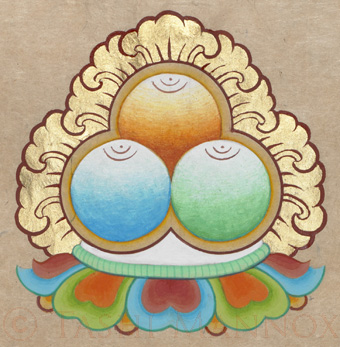
For Buddhists and especially Tibetan Buddhists, the three fold refuge ‘Buddha, Dharma and Sangha’ is known as ‘The Three Precious Jewels” དཀོན་མཆོག་གསུམ། 
This is typically illustrated as above and at the top of the below calligraphy art piece; as three round precious jewels seated on a moon disk and multi-coloured lotus flower, the three jewels are decorated with a radiating golden leaf like pattern.


To take refuge is to simply put ones trust or confidence in those who have fully liberated them selves from 'samsara' such as a Buddha, by following the Dharma teachings with the guidance of the Sangha on the path to enlightenment. Until i am free from confusion and suffering, i take refuge in the Buddha, Dharma and Sangha.


The Threefold Refuge:

"Homage to the Three Jewels" 57x84 cm ⓒ Tashi Mannox 2012.
Available as a limited edition print.

The above calligraphy art piece illustrates from top to bottom four classic calligraphy traditions of India, Tibet and Ireland:

~ Sanskrit Lantsa that reads namo buddha ya, namo dharma ya, namo sangha ya.
The Buddhas teachings were originally transcribed in Sanskrit belonging to India, that has evolved over the centuries into many different forms of script styles. Lantsa was a very early such style that many of the Buddhist manuscripts were created in. It was these Lantsa manuscripts that migrated into Tibet and formed the bases from which the Buddhist teachings where first translated into Tibetan.

~ Tibetan Uchen script this is a phonetic translation of the above Sanskrit that also reads as namo buddha ya, namo dharma ya, namo sangha ya.
It is said that the Uchen script style was evolved to accommodate the translation of Sanskrit manuscripts from India, indeed there are some similarities in construction and letter forms, though Tibetan is a totally different language to Sanskrit, many original Sanskrit terms and mantras where maintained phonetically in Tibetan, as to preserve the original sound and to up-hold what was considered a sacred language, such as Latin is to Christians. 

~ Petsug script that is a translation of the above in Tibetan that reads sange la chag-sal lo, chö la chag-sal lo, gendun la chag-sal lo, meaning to bow down with folded hands to the Buddha, Dharma and Sangha. 
Petsug is one of many handwriting styles of Tibetan calligraphy, quicker to form than the Uchen script, it was commonly used to scribe manuscripts. 

~ Celtic English script that is a translation and phonetics of the original Sanskrit.
Perhaps a sacred English script; historically the great Christian manuscripts were scribed in Celtic scripts, which did not belong only to Ireland as we know it today, but the Celtic Christian influence spanned over Scotland, Wales, England and into Europe. 

Created for an exhibition in December 2012 at the Contemporary Calligraphy museum in Moscow. Chinese ink and Japanese mineral paint, 23.6ct gold leaf on Bhutanese tsasho paper, ⓒ Tashi Mannox 2012.


"homage mudra" 48cm diameter, ⓒ Tashi Mannox 2012.  


Another new piece by Tashi Mannox is to illustrate the 'mudra' of folded hands at prayer, painted in the way of traditional Thanka draftsmanship, there is a modern twist of folded back Western shirt sleeves and wrist watch on the traditional depicted arms and hands. 
Mudra means 'gesture' above the gesture of prayer is the word 'namo' meaning homage, this is in the Sanskrit Wartu script painted in a Japanese mineral earth red, below which in Tibetan Tsugmakhyug script translates as "hands held together at the heart in the gesture of prayer".


The Fourfold Refuge:

"Homage the the Fourfold Refuge, 54x84 cm
ⓒ Tashi Mannox 2012. 
Available as a limited edition print.

The main body of calligraphy of the above Four Refuges piece is painted in a historic 'high' form of Uchen, inspired by a 16th century manuscript from the seat monastery 'Tsurphu' of the Karmapa Lama's in central Tibet.
The Four Refuges: 'Lama, Buddha, Dharma and Sangha' are highlighted in rust red mineral paint. 

The first dark maroon characters 'na mo' in the Lantsa Sanskrit script translates as 'homage' at the end of the prayer is a 'full stop' character in the same Lantsa Sanskrit script.
The smaller lettering in red also at the end of the refuge prayer, translates as "the four fold refuge" 


In the Tibetan Buddhist system the Lama or Guru has become an equaled source of refuge, who a realized personal known as a 'root' teacher who has the ability to guide and point out the nature of ones mind, is called a Lama. 

Private collection. Chinese ink and Japanese mineral paint on Bhutanese Tsasho paper ⓒ Tashi Mannox 2022.


Saturday, 11 February 2012

Printing black པར་ནག།

"Homage to Mahakala" now available as prints.

"homage to Mahakala" Ⓒ Tashi Mannox 2012

The Image of Mahakala the great black one, with his all seeing bulging eyes of the past, present and future, snarling and bearing teeth to bite trough ego clinging, is somewhat demon looking, though what Mahakala represents is the wrathful quality of compassion that is sometimes needed to cut through the more stubborn inner and outer obstacles, as we tread the precarious path to enlightenment. 

A protector of the Dharma, Mahakala is considered a manifestation of Buddha activity that as a Yidam practice transforms anger and hatred into lovingkindness and wisdom. For this reason it is especially practiced at the end of the old year, to chase away any old baggage and obstacles to clear a way for the new year. 

This particular image of Mahakala, bearing his name as his teeth, has been popular and admired by many who have asked its availability as a print. 

Tashi is pleased to say that after some very skillful photography by professional means, plus much attention and care to maintain the subtly of the multilayered effect of the black on black inks, that was previously not thought possible to replicate. It is now available to order a limited edition print of this iconic image.

To give the prints a special dimension, the eyes iris are hand gilded with 23.6ct red pure gold leaf, that illuminate and enrich the prints splendor.

The prints are limited to editions of 100 in three sizes:

- Large size of 67x50 cm, 26½"x19¾" inches @ £395 GBP
- Half size of 50x37.5 cm, 19¾"x14¾" inches @ £295 GBP
- Small size of 35x26 cm, 13¾"x10¼" inches @ £255 GBP


As reproductions are printed to order and hand finished, delivery of prints may take from 5 days to two weeks to arrive from the date of payment.
Additional Post and shipping costs may vary depending on where you are based in the world, please provide the address you wish the print to be sent to when contacting Tashi, so that the correct costs can be calculated and quoted.


Design originally by Tashi's master of art Sherab Palden.


Sunday, 29 January 2012

Creating a golden world


The word gser in the Petsug script
meaning 'gold'.

The Creation process of the calligraphy art piece called "Primordial Purity, Golden World"


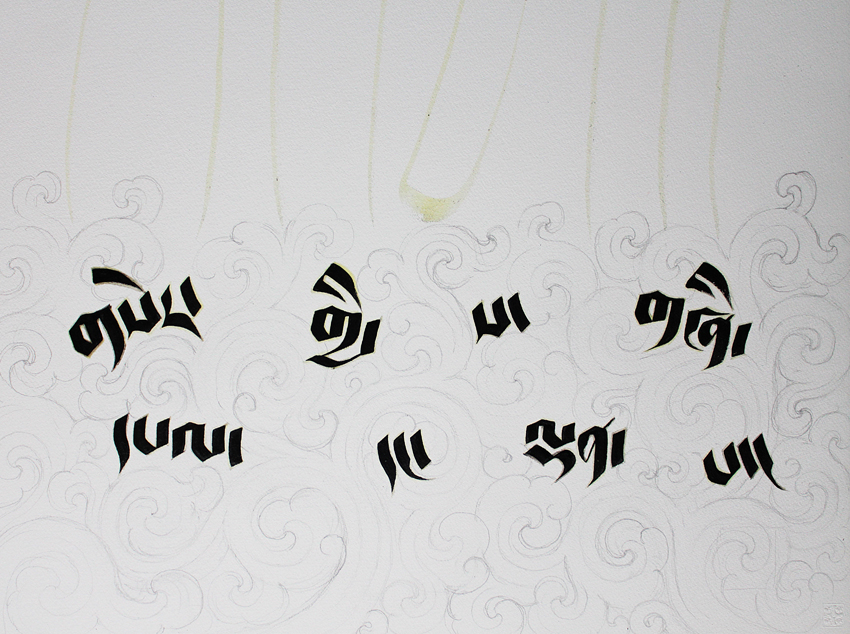
First calligraphy in black ink that is set out with ample space to draw in a swirling leaf like pattern to be later painted and gilded. This particular calligraphy style is called Petsug script, that has a compact square bold character, purposely placed irregular as if to dance across the paper. The text translates as "the mythological golden basis/ground of our know world, that is glorious and magnificent"


Other calligraphy painted with a latex rubber masking fluid that resists any water based paint. The above detail shows the rubber mask being removed with an eraser to revile the clean white paper below. The below image shows the calligraphy in full, these words at the top of the piece are painted in a long tailed form of the cursive Drutsa script, known as 'round tailed Drutsa', that translate as 'universal, common ground of primordial purity'.


Shades of yellow ochre pigment provides a suitable base to apply both gold and copper leaf. The top and bottom calligraphy together translates as 'The universal basis of primordial purity (of our mind/being). The glorious golden ground (of our world).


Above, a detail showing gold and copper leaf mapping out the swirl pattern.


A mass of swirling gold and copper leaf reflects the light brightly on the rough texture of the water-colour paper, where light is not reflected the swirl pattern appears darker than the background yellow ochre. 


Primordial Purity, Golden World.

The universal basis of primordial purity (of our mind). The glorious golden ground (of our world)
The splendor of the universe, our world, from where we are born and return, can be experienced by us from a sacred viewpoint of our innate purity that is naturally within us. This interrelationship between heaven and earth evokes the creativity of man, expressed in words and the beauty of calligraphy.
The uppermost line of Tibetan cursive script that soars high in the sky translates as “universal, common ground of primordial purity”. Below, as if dancing among the swirling energy of the earth are black letters that translates as “the mythological golden basis of our known world, glorious and magnificent”. 
ⓒ Tashi Mannox, 
53x76 cm Dutch gold and copper leaf on a ground of acrylic paint.

Limited edition prints are also available of this art piece and two others that feature in the Sharjah Calligraphy exhibition, for all enquires and to place an order for a print, please contact Tashi Mannox here.


The word 'truth' in an ornamented Petsug script style, this is a detail of a larger art piece created for the Sharjah Calligraphy Biennial 2012. this is also available as a limited edition print and is shown in full, featured here.


All images shown in this post ⓒ Tashi Mannox 2012