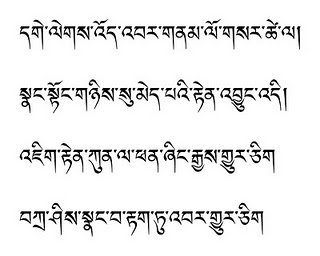
RELATED TIBETAN SCRIPTS
Showing posts with label Losar. Show all posts

Wednesday, 6 February 2013

ཆུ་མོ་སྦྲུལ་ལོ། Tibetan New Year Greetings.


Auspicious Good Wishes for the New Year of the Female Water Serpent
2013


༼ཆུ་མོ་སྦྲུལ་གནམ་ལོ་གསར་བཀྲ་ཤིས་བདེ་ལེགས་ཞུ༽


Thursday, 23 February 2012

Drawing Dragons

Good Wishes for the year of the Male Water Dragon 2012......


"According to the astrological qualities of the Males Water Dragon, this year is set to be a strong dynamic year of activity, though special attention is needed to not to let projects run out of control. Indeed the posting of my Losar Tibetan new year good wises to everybody is a day or two late because i simply did not have the time away from an already very busy schedule of exhibition dead-lines and commissions to be completed. 

The above drawing, is a study in preparation for a larger art piece of a 'water Dragon' that i plan to complete this year, but would have been nice if i had the chance to complete the piece in celebration of the Tibetan new tear.
The Eastern Dragon has been beautifully depicted over the centuries and differ stylistically from one country to another nation. This mythical beast representing wisdom and power of the elements; is full of symbolism and complex in iconography, that personally has always intrigued and challenged me to draw well."

-Tashi Mannox 23rd February 2012

Friday, 4 March 2011

Obstacle Clearance


'Homage to Mahakala' the face of the Great Black one, Tashi Mannox 2007

On the last day of the Tibetan year prayers are offered to the wrathful Dharma protector called Mahakala 'the Great Black One'. This is traditionally an all day sadhana སྒྲུབ་ཐབས practice to clear away obstacles of the old year to clear the way for a peace and progress in the Dharma. It is a cathartic and effective way to let go of negativity and purify body speech and mind of the new year ahead.

The yearly Mahakala practice culminates with a ceremonial 'cham' dance to symbolically chase out and repel the demons of the old year, called the black hat dance. The main character of the dance is usually performed by a high Lama who is particularly attained in  the visualization of the sadhana, who's role is given the title dorje lopon. 

The Mahakala dance has its origins from a time in historical Tibet when an anti-Dharma King was shot with an arrow from a bow concealed in the long pointed sleeves of the gown worn by the dancers of his court. This has since become symbolic of the victory over the inner and outer obstacles one may encounter on a spiritual path.  A similar costume is worn today together with an apron depicting the face of Mahakala, the protector of the Dharma.

A young Gyaltsab Rinpoche wearing the black hat dance costume at Rumtek
monastery in Sikkim. Photography by Peter Mannox.

With the dust of the old year symbolically clean away, it is traditional for a more practical spring clean of the household in Tibet, which with the celebrations of the new year 'losar' and on this day only, the servants of the house would be allowed to swop cloths and roles with the masters, in a party atmosphere of joy and a refreshing shake-up of conformity.


The Tibetan New Year of 2011 bounds in with the Female Iron Hare or Rabbit, which is said to be a particularly joyful and prosperous year ahead.


May goodness increase.

Wednesday, 2 February 2011

Losar good wishes 2011


All the very best
 for a happy 
and prosperous 
year of the 
female Iron Rabbit.


"As the light of this New Year blazes

With excellent virtue and happiness
May these dependently arising appearances inseparable from emptiness, 
Bring benefit and prosperity in all the worlds there are,
May the light of auspiciousness always blaze bright"

Composed་by Khenpo Tsultrim Gyamtso Rinpoche at Tek Chok Ling near the great stupa in Boudhanath, Nepal, February 2010. Translated by Jim Scott.


Saturday, 13 February 2010

Iron Tiger


Happy Losar !

Tibetan new year of the Metal Tiger.


Kagyu Tiger, From the Black-on-black series, Tashi Mannox 2008.
102x73 cm, mounted board, gold and silver leaf.

The three hum characters in gold, that ride the back of the tiger are the three essential syllables of the Dorje Drolo yidam practice, a wrathful manifestation of Guru Rinpoche, Padmasambava, practiced to overcome inner and outer obstacles.


May it be a year of Iron like strength, to accomplish all wishes swiftly as a tigers leap.


Click here to view a Losar 2010 good wishes from H.H. 17th Karmampa, Ogyen Trinley Dorje.