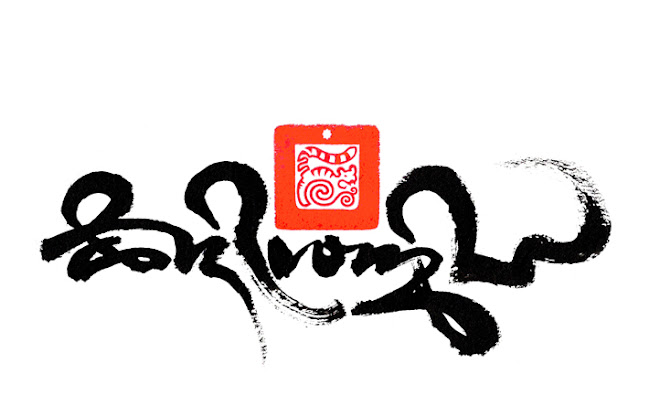
RELATED TIBETAN SCRIPTS
Showing posts with label news. Show all posts

Sunday, 8 September 2013

Tashi's own.....


A Gallery solely dedicated to fine Tibetan scriptural art is perhaps the first of its kind in the western world? But is defiantly a first for internationally celebrated contemporary Tibetan calligraphy artist Tashi Mannox. 


This September launched the “Tashi Gallery” pleasantly situated in the heart of the famous town of books Hay-on-Wye. This is a very popular destination for it's surrounding beauty in Brecon Beacon National Park and hosts the yearly internationally acclaimed Hay Book Festival. 
The picturesque Welsh border town nestles below the Black Mountains on the banks of the majestic River Wye, is a lively cosmopolitan town that boasts a wealth of arts and literature. Only such a town can comfortably accommodate a Gallery of Dharma art of Eastern origin.

Tashi Gallery exclusively offers original art masterpieces as well as excellent quality limited edition prints of Tashi Mannox's complete works. Also for Eastern Calligraphy enthusiasts, there is an opportunity to select the finest quality Japanese seal inks, Tashi Mannox has collaborated with the oldest Japanese traditional seal ink makers to create four different color shades of vermilion pigments representing 'The Four Season'.  This is also the first time such quality inks are made available in the West.


Tashi's hand fashioned 'chops'
Japanese 'summer' colour natural vermillion seal ink


"As the art of beautiful hand writing finds a new place within the modern world, it is heartwarming to see that such writing traditions are not only being practiced but also upheld with excellence and dignity. Such organizations as the Contemporary Calligraphy Museum in Moscow, the Contemporary Calligraphy Museum in Sharjah and now the Tashi Gallery all contribute to deliver ancient wisdoms for the modern mind”

Tashi Gallery # 2 The Pavement, Hay-on-Wye, on the Welsh border of Herefordshire, HR3 5BU, UK.

Gallery open from 11 am - 5 pm Saturdays only during January and February 2014. or by appointment please contact Tashi on 01497831167 - 07855 387067

Public transport: Trains to Hereford Station, near the station approach take the 39 bus toward Brecon, alight in Hay-on-Wye, click here for bus time table. 
The Tashi Gallery is found at the heart of Hay-on-Wye just up from the clock-tower.


, 


Tuesday, 1 November 2011

Bamboo pen


Tibetan artist strives to sustain traditional calligraphy
LHASA, TIBET, Nov 1st 2011 Xinhua Chinese news paper reports -- 
Kalnor is among the few people who still practise traditional Tibetan calligraphy with a bamboo stick on a wooden board.
The 50-cm long, 25-cm wide birch board, known as "jangshing" in Tibetan, was an essential stationery item for Kalnor and his peers when they first learned to write.
"We had to practise on the jangshing for at least two years before we could write on paper," said Kalnor, 31.
The jangshings for beginners were often marked with four lines, and the number of lines was reduced as the students' writing improved, until only one line was left to mark the location of the text.
According to Kalnor, the ancient writing material was economical and green, as old jangshings could be used anew after being washed in the river and dried again.
Image showing the traditional birch wood board called a jangshing.
As a child, Kalnor used bamboo sticks for a pen. The makeshift ink almost always came from the kitchen -- charred barley or soya sauce.
"When we wrote on the jangshing, we sat on the floor with legs crossed and wrote every stroke with patience," Kalnor said. "It was not just a practice of calligraphy -- it was also a process of extreme concentration and meditation."
The jangshing is dusted with chalk through which the letters are practiced
with a bamboo pen dipped in water.
A master of fine arts, Kalnor is now an art teacher at a secondary school in Duilong Deqing County on the outskirts of Lhasa. "Children who learned to write with the jangshing concentrate easily on everything they do."
The past two decades of modernization, however, have led to the traditional writing boards being replaced by well-printed exercise books and computers. Few children still use the jangshing even in the remote herding areas.
Beginning in 2008, Kalnor traveled across Tibet searching for jangshings and expanding his private collection of the traditional writing pad that will soon fade from the public memory.
"It would be a pity if we lose this part of Tibetan culture," said Kalnor at his gallery on Barkor, a famous commercial street in the heart of Lhasa.
Kalnor has proudly put his favorite jangshing collections on display at the gallery, including one inherited from his father. The jangshings were shown alongside his modern Tibetan paintings on handmade papers and works of butterfly and Tara -- a female Buddha in Tibetan Buddhism.
Phubu Tsering, a visitor to the gallery, said he still remembered how he learned to write the Tibetan alphabet on a jangshing when he was 6.
"My mother made me some ink by adding water to barley flour that was fried dark. Sometimes she added sugar to make the liquid thicker, and I used to suck my 'pen' to taste its sweetness," said Phubu Tsering, 46.
For many Tibetans, jangshing and traditional Tibetan calligraphy are an important part of their collective memory.
"Many things of the good old days will be replaced by new things, and it might not be practical to keep jangshing, but this writing tool certainly played a major role in Tibetan education, so we should at least carry forward the essence of the traditional culture it represents," Kalnor said.