RELATED TIBETAN SCRIPTS
Showing posts with label calligraphy. Show all posts

Monday, 25 April 2016

Thönmi Sambhota Thangka


Thönmi Sambhota Thangka description

This is a traditional thangka* painting, which was especially commissioned by Tashi Mannox on the rarely depicted great calligrapher and scholar Thönmi Sambhota.
Sambhota is reputed to be a historical figure responsible for developing the foundation of the Tibetan writing systems in the seventh century A.D, which form the basis of the Tibetan language today. See below for the History of the Tibetan Writing System.

In this thangka, Thönmi Sambhota is shown as the main figure wearing traditional attire of a Tibetan layperson, though wears a white turban in reference to his many years spent in Northern India studying chiefly Sanskrit with Brahmins and Pandits.


He holds in his lap a tablet inscribed with a rendition of a Mani mantra, oṃ maṇipadme hūṃ, which was presented to Dharmaraja King Songtsen Gampo as the first sample he created of the Tibetan Uchen script. The original writing of this mantra was carved on a rock in Rigsum Gompo temple in central Tibet, which was unfortunately destroyed during the Cultural Revolution.


On a table before Sambhota are laid out calligraphy implements such as ink and bamboo pens, cut from the bamboo grove behind him. Tibetan manuscripts also sit before and behind referring to Sambhota’s scholarly achievements and the Tibetan grammar and punctuation he composed.


Emanating from Sambhota on rainbow beams are two golden disks marked with the letter Aa ཨ the last letter of the Tibetan alphabet, which is also considered the essence and expression of the entire alphabet in one.  On the left is Aa ཨ in the classical Uchen script and on the right is the same letter Aa ཨ in the Umed class of scripts. These represent the two main groups of script styles he created and still in use to the present day.


The thangka painter Sahil Bhopal entrusted Tashi to personally add the two principle letters Aa ཨ to the golden disks, as well as the Mani mantra within the thangka.


To Sambhota’s below right is a student in practice of calligraphy. While above is a scene of nature, more typical of the Karma Gadri style of thangka painting, with trees and a cascading waterfall bringing prosperity. 
In the far distance are five mountains of Manjushri, the deity of learning, or can also represent the five Wisdom Buddha families.


 In the sky above is Sakymuni Buddha, who crowns Thönmi Sambhota representing his Buddhist belonging, and motivation to benefit all.


*Tibetan thangka painting is one of the great arts of Asia. A particular stylistic development of painting in natural mineral media, normally on cloth which is mounted in a brocade frame, designed to role up as a portable scroll.
Thangkas are typically rich in iconography of their religious content that communicate the highest Buddhist ideals, often as a visual aid to be meditated upon or to depict historical figures and spiritual events. For a Tibetan Buddhist, thangkas are considered inspirational sacred paintings in their physical support to a practitioner as an embodiment of enlightenment.


History of the Tibetan Writing System 

It was during the seventh century reign of Tibetan King Songtsen Gampo, and under his direction, that the first iteration of what would become the modern day Tibetan written language came into existence. Prior to this Tibetans had used Mayig, a comparatively rudimentary system. But Songtsen Gampo was faced with the task of translating the wealth of existing Buddhist Sanskrit texts into Tibetan, and needed a coherent writing system with sufficiently rich symbolism. He turned to minister and great scholar, Thönmi Sambhota, who along with sixteen other wise ministers travelled to India to study Sanskrit. Only Sambhota would return suitably qualified. His journey had proved fruitful, however, and a new Tibetan writing system, based loosely on Indic Sanskrit was established. It is worth noting that the Tibetan spoken language remained the same; only written language was renovated. Sambhota had conceived an alphabet and standardised writing conventions, including grammar and punctuation, and would later also produce the first iteration of both the Uchen and Umed forms.
Different script styles developed over the next several hundred years. In the early ninth century the Tibetan script underwent another transformation and ‘Old Tibetan’ was standardised to ‘Classical Tibetan’. One thousand years passed, yet Tibetan calligraphy persevered, steadily evolving towards its contemporary form. By the nineteenth century the models of Uchen and Umed, the two main Tibetan script styles, had ossified and bore the exact proportions still in use today.

Tibetan Calligraphy & Tibetan Buddhism

From the offset, then, a notable bond existed between the Tibetan writing system and Buddhism – its creation being motivated primarily by a need to conserve and decipher Sanskrit Buddhist manuscripts. To limit calligraphy and Tibetan Buddhism (and by association Tibetan culture’s) connection to simply a functional conception, however, does not do justice to their relationship. The two are largely inseparable and have remained so to the present day. Tibetan Buddhism is considered a ‘live’ tradition, comprised of many lineages in which a master will impress the totality of a line’s knowledge on a disciple. The lineage is also considered fluid, as the disciple then realises the wisdom of these teachings through meditation. Clearly, the academic and meditative aspects of Tibetan Buddhism are closely linked. Calligraphy’s role in this relationship as a key by which existing Buddhist teachings are unlocked compounds its status. Developing a written language certainly also had administrational benefits for the empire, with its use in legal and historical documents.

-Luke Purdye


Friday, 6 February 2015

Appreciated in Lhasa.


Two good friends of Tashi recently got in touch with a surprising discovery, Joona Ripo and Matthew Linden during their winter study at Lhasa University, stumbled upon a typical Tibetan tea house on the Barkhor that surrounds the holy Jokhang temple in old Lhasa.

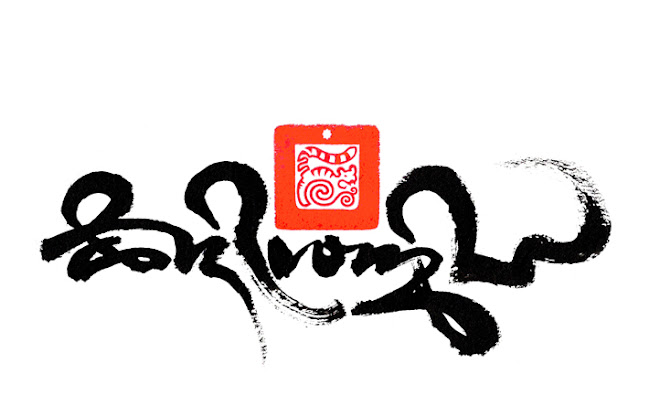
What caught their eye was a recognisable image above the entrance doorway, unexpected and out of context, yet at the same time comfortably at home, was a print of one of Tashi Mannox's art pieces "Kagyu Tiger". 
Being familiar with Tashi's work, they entered to find many more of his works covering the walls of the establishment. Astonished to find this 'voluntary exhibition', the owner was unaware of the artist and did not admit to how he acquired the prints, which where obviously lifted and printed from Tashi's website. 

When this news reached Tashi along with these photos from Matthew Linden, he remarked that it was an honour to have such an 'exhibition' not only in such a sacred place of great connection and blessing so near to the Jokhang, but more so, that the Tibetans themselves value his art and hang it as their own, what a huge compliment!


This last photo below in the tea room shows a group of young Tibetan lads all engaged with their cell phones. The iPhone is apparently the popular choice among Tibetans, mostly because it has an app for writing in the Tibetan language. 


Joona and Matt also commented that they often see Tibetans with a Tashi artwork used as their screen wall paper, as shown below.


Friday, 12 April 2013

Calligraphy of paper and stone


For those who enjoy the art of beautiful letterform, be it inked on paper or incised in stone, of both East and Western traditions. You may enjoy to adventure out to contemplate art in a clear fresh gallery space or dwell in nature to enjoy the freedom of wondering between sculptures of wise words.....

From the 4th May to the 30th June 2013

Internationally celebrated Richard Kindersly and Tashi Mannox hold a joint exhibition at The Monnow Valley Arts Centre, majestically located beside the Black Mountains of the Brecon Beacon National Park.

From its purpose built art studio, galleries and beautifully arranged gardens, dotted with scriptural carved standing stones and other sculptural wonders, is a view that inspires greatness and lifts the heart.


Throughout the gardens Richard Kindersly exhibits his calligraphy sculptures called 'Material World'. In this exhibition Richard explores the difference between gestural and geomatrically constructed letter forms. These are skillfully demonstrated as carved letters in sandblasted glass, moulded concrete, wood, steel and paper (sometimes with the same text) to show us how lettering can be used in unusual ways and unusual materials.


While in the studio gallery Tashi Mannox exhibits a collection of works called 'Illuminated Optimism' from his Contemporary and traditional calligraphy series, depicting positive and thought provoking Tibetan Buddhist themes in a medium of ink on paper. Such as his first public showing of 'Hog eats Cock eats Snake' which represents the basic foundation of Samsara and the three aspects of ego: delusion, attachment and aversion, that feed on each other in a perpetual cycle. To remedy this on the path to liberation, Tashi illustrates the classical 'Four Foundations', four topics that are traditionally meditated upon, that lay a firm foundation of right motivation and diligence on the path to enlightenment.

The original Art pieces in the exhibition have been the basis for a series of high quality, limited edition Giclee prints that are also available for sale, making these works accessible to all.

A new embossed mantra art piece also premiers at the exhibition. This piece is the first of a new series of 'ink-less' calligraphy pieces which again demonstrates the diversity of Tashi's talent in bringing the integral tradition of Tibetan calligraphy into the 21st century.


The Immaculate Ushnisha mantra
om padmo ushnisha bi ma le hum phat

གཙུག་ཏོར་དྲི་མེད།

This is a purification mantra that is traditionally displayed on a beam or above a doorway.
It is said that the mantra has the power to bless and cleanse every-time one passes below, and is sometimes named as the ‘mind your head’ mantra.  


The Monnow Valley Art centre is open to the public:
Wednesday - Friday 11am - 5pm
Weekends 2 - 5pm

Entrance to gallery exhibitions is free, but a donation is requested if not visiting the gardens.
Entrance to gardens, sculpture and National Collection of Contemporary Memorial Arts is by donation of £5 per adult (concessions £3) children under 14 for free.

The Monnow Valley Arts Centre   see map
Walterstone
Herefordshire
HR2 0DY

01873 860 529


Previous incarnations and new Art


A rare and remarkable old photo of the 16th Karmapa flanked on his right by the 11th Situpa and to his left the 6th Ponlop Rinpoche. 

The photo is believed to be taken in the Late 1940's early 50's near to the seat Tsurpu Monastery of the Karmapa's who is the head of the Kagyu linage.

These three great Kagyu Lamas have since incarnated to continue their linage as realized teachers to benefit all sentient beings. 


It is notable that all three present incarnations are great calligraphy artists. The previous Ponlop Rinpoche was also an accomplished Thanka painter, who has continued his talents in a new medium  till the present day.

'Ego' in English and Tibetan,
by Ponlop Rinpoche.

In old Tibet, at the time of the above photo, calligraphy was practiced as a discipline to a high degree, however was not created as a free expressive art-form as it is in the Japanese Zen tradition. It is only through these new incarnate Lamas, who are engaged with communicating Dharma in the world away from Tibet, that Tibetan calligraphy has developed and established a new expression.

'Kagyu' Tibetan calligraphy by
Tai Situ Rinpoche.

Another great Lama and Kagyu linage holder Chogyam Trungpa Rinpoche and was the first to make this new artistic leap, while establishing Buddha Dharma during the 70's and 80's in America. 
Trungpa Rinpoche created expressive calligraphy art that was a bold and free break-away from the precis Tibetan handwriting styles, followed closely by 12th Tai Situ Rinpoche. Though it is not clear if it was Trungpa who set the new trend or if there was a general awakening of creative expression.

'Dharma' Tibetan calligraphy
by Chogyam Trungpa Rinpoche.

If it was not for the brilliance and initiative of the early Tibetan Lamas communicating Dharma, there would not be such a strong and lively practice of Tibetan calligraphy that has established its own place within the contemporary art world.


The late Chogyam Trungpa Rinpoche


Sunday, 27 May 2012

Illuminated Insights


During the world famous Hay Festival of literature and the arts situated below the majestic Black mountain's of the Brecon Beacon National Park. In celebration of the opening of the Richard Booth’s cinema, premieres an exhibition of contemporary Tibetan Calligraphy by Tashi Mannox.

The exhibition called ‘illuminated insights’ spans the last decade of Tashi’s calligraphy masterpieces, that shows a selection of his works including the large and rarely exhibited iconographic ‘Soulhouette’ pieces. Others shown are the more traditional calligraphy artworks that illuminate the wisdoms of Tibetan Buddhist themes, such as ‘The Four Contemplation’ series, as well as small insightful gems that Tashi has brushed in the various Tibetan script styles to delight the eye and stimulate the mind.


'Male Soulhouette' Chinese ink on a scroll of heavy water-colour paper, 114 cm x 206 cm Tashi Mannox 2002.


Saturday, 25 February 2012

Iconographies of Dharma

Photograph by Rebecca Von Ommen. 

Michael Schwartz writes:
Integral Calligraphy

Calligraphy is the art of beautiful writing, the art of exquisite hand-written linguistic marks. Such is the aesthetic impact of the script that the verbal meaning need not be understood for the calligraphy to shine forth in profound significance.

Many world-historical cultures have evolved ramified calligraphic traditions, perhaps most well-known being those of Asia and Islam. Less popularly acknowledged amongst the Asian traditions, Tibet has its own remarkable lineages of calligraphy.

Tashi Mannox, an Englishman, and for many years an ordained Buddhist monk, has trained for decades in the arts of Tibetan calligraphy. Today he preserves this tradition as a vehicle to communicate and transmit dharma, all the while adapting and updating his approach within and for contemporary contexts. He identifies three streams in his work: (1) contemporary and traditional; (2) contemporary black on black, and (3) illuminated iconography.

In honoring contemporary contexts and concerns, some of his designs are presented as sacred tattoos. With certain commissioned work he offers the option of including bespoke seals that are specific to the calligraphic project and its patron. In all cases Tashi's art is an expression of his long and devoted meditative practice and spiritual realization, such that his art energetically transmits the Tibetan Buddhist View.

Several of the circular designs in the present exhibition approach the status of calligrams—the arrangement of script to form a picture—a device most often associated with strains of Islamic artistic practice and with experiments in Western modernism aligned with the poet Guillaume Apollinaire. A work like Emanate from Emptiness and Samsara—Cyclic Existence visually articulates the verbal meaning in a picture-like manner, amplifying rather than compromising the calligraphic beauty and integrity of the script itself. Indeed, the variety of Tashi's approaches is astonishing. With a work like Primordial Purity, Golden World, the pictorial is no longer built up from the script, but is an image in its own right, aspects of the script incorporated then meaningfully and expressively into the image. With Hum, Jyo-Protection, the mark-making itself is of a refined exquisite delicacy, the script streams and seals composed on the page to generate extraordinarily aesthetic coherence and expressive nuance.

Grounded thoroughly in the pre-modern Tibetan tradition, incorporating modernist visual schemes, and being multi-cultural and postmodern in drawing on other calligraphic lineages such as the spatial awareness proper to Zen calligraphic practice (while preserving the Tibetan core of style), Tashi Mannox's art is an authentic and exemplary instance of an integral calligraphy for our age.

February 2012


Tuesday, 31 January 2012

Illuminated Manuscripts exhibition

From the 6th April -September 3rd 2012, The Rubin Museum of Art in New York City presents the exhibition 'Illuminated': The art of sacred manuscripts explores the aesthetic and technological approaches in creating and adorning books from a variety of cultures and features illuminated Tibetan manuscripts dating as early as the 13th century.

A detail of a 17th century Tibetan manuscript.
Take the link here for more details on the exhibition.

Sunday, 29 January 2012

Creating a golden world


The word gser in the Petsug script
meaning 'gold'.

The Creation process of the calligraphy art piece called "Primordial Purity, Golden World"


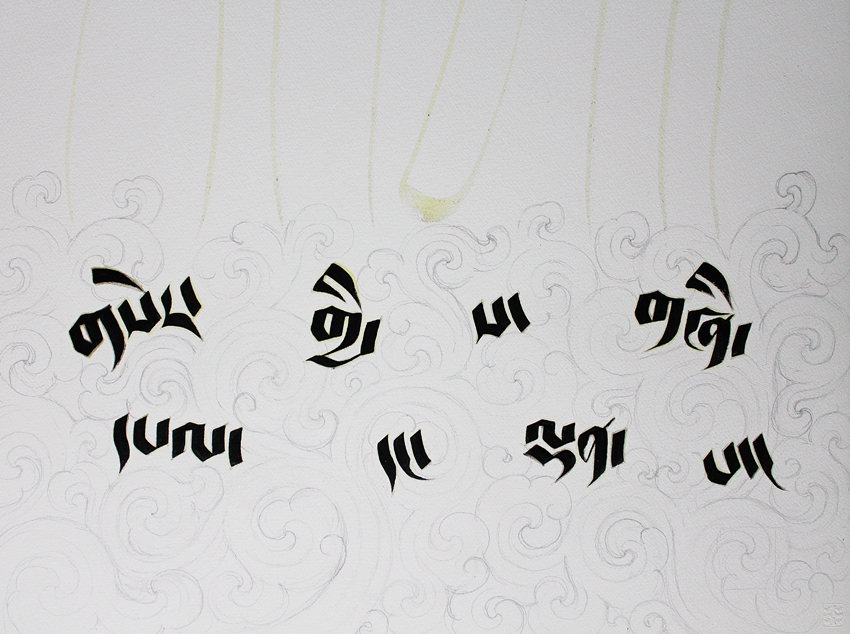
First calligraphy in black ink that is set out with ample space to draw in a swirling leaf like pattern to be later painted and gilded. This particular calligraphy style is called Petsug script, that has a compact square bold character, purposely placed irregular as if to dance across the paper. The text translates as "the mythological golden basis/ground of our know world, that is glorious and magnificent"


Other calligraphy painted with a latex rubber masking fluid that resists any water based paint. The above detail shows the rubber mask being removed with an eraser to revile the clean white paper below. The below image shows the calligraphy in full, these words at the top of the piece are painted in a long tailed form of the cursive Drutsa script, known as 'round tailed Drutsa', that translate as 'universal, common ground of primordial purity'.


Shades of yellow ochre pigment provides a suitable base to apply both gold and copper leaf. The top and bottom calligraphy together translates as 'The universal basis of primordial purity (of our mind/being). The glorious golden ground (of our world).


Above, a detail showing gold and copper leaf mapping out the swirl pattern.


A mass of swirling gold and copper leaf reflects the light brightly on the rough texture of the water-colour paper, where light is not reflected the swirl pattern appears darker than the background yellow ochre. 


Primordial Purity, Golden World.

The universal basis of primordial purity (of our mind). The glorious golden ground (of our world)
The splendor of the universe, our world, from where we are born and return, can be experienced by us from a sacred viewpoint of our innate purity that is naturally within us. This interrelationship between heaven and earth evokes the creativity of man, expressed in words and the beauty of calligraphy.
The uppermost line of Tibetan cursive script that soars high in the sky translates as “universal, common ground of primordial purity”. Below, as if dancing among the swirling energy of the earth are black letters that translates as “the mythological golden basis of our known world, glorious and magnificent”. 
ⓒ Tashi Mannox, 
53x76 cm Dutch gold and copper leaf on a ground of acrylic paint.

Limited edition prints are also available of this art piece and two others that feature in the Sharjah Calligraphy exhibition, for all enquires and to place an order for a print, please contact Tashi Mannox here.


The word 'truth' in an ornamented Petsug script style, this is a detail of a larger art piece created for the Sharjah Calligraphy Biennial 2012. this is also available as a limited edition print and is shown in full, featured here.


All images shown in this post ⓒ Tashi Mannox 2012