RELATED TIBETAN SCRIPTS
Showing posts with label Moscow Calligraphy museum. Show all posts

Tuesday, 14 October 2014

Tibetan Calligraphy in Moscow


From the 24th October to 3rd November 2014, Tashi Mannox will be in Moscow to open his first solo exhibition in Russia as well as to lead a Tibetan calligraphy course and well as other public talks.


For more information about the program of events and to book a place on the calligraphy course, please visit the website of the 'Foundation of Contemplative Studies'. who are hosting Tashi during his short stay in Moscow.


The exhibition shows several original art pieces and limited edition prints that span his 15 years of creativity within the art world can be seen at the "Two Empires" gallery on Voznesensky, a side-street just minutes from Red Square at the very heart of Moscow.

On Sunday 2pm, November 2nd Tashi will give a lecture on 'The Art of Tibetan calligraphy' at the prestigious Contemporary Museum of Calligraphy. 
Tashi has been a long term participant with the Contemporary Calligraphy Museum whom during this time will show a number of other of Tashi's art pieces that have been both donated and on loan with the Museum since 2008. 


✮


Monday, 22 October 2012

4th International Exhibition of Calligraphy - Moscow


Once again the Russian Federation hosts the worlds foremost exhibition of contemporary calligraphy in Moscow. This 2012 biannual event runs between 1st November until the 15th December. A diverse and colourful exhibition that represents over 40 world class calligraphy artists of different language traditions, who have contributed calligraphic masterpieces to celebrate the beauty of handwriting, excelling their artistic abilities in the name of keeping such calligraphy traditions alive.

The exhibition officially opened on the 1st November with a grand event that attracted much media attention as captured here.

A beautifully styled catalog of the exhibition artworks and their creators has been skillfully made available 'electronically' :


There is also a 'virtual excursion' that allows remote live viewing of the exhibition via CCTV cameras placed strategically around the gallery halls.


Since the Contemporary Calligraphy Museum of Moscow first held their international calligraphy exhibition in 2008, Tashi Mannox has been invited to exhibit with three of their biennials. This year Tashi especially created two art pieces and donated a third for the 2012 show.

One such piece especially created, as shown in the above snap-shot of the catalog, called "Homage to the Three Jewels" can also be seen with a more detailed explanation in a previous blog post here.

The other calligraphy art piece exclusively created for Moscow is called "The Four Immeasurable States" (as below) another calligraphy based on a classical Buddhist theme and popular for a strongly growing Buddhist community in Russia.

༄། ཚད་མེད་བཞི། །

"The Four Immeasurable States"
Chinese ink and Japanese mineral paint on Bhutanese tsasho paper, 
57x84cm ⓒ Tashi Mannox 2012.

Seated on the four open lotus flowers are the four immeasurable states:


བྱམས་པ་  སྙིང་རྗེ་  དགའ་བ་  བཏང་སྙོམས་
Love,   Compassion,   Joy,   Equanimity.
These four key words are highlighted in blue calligraphy of the Drutsa script style.  Below which is a round tailed Drutsa script from the 14th century Tibet. This particular rare round tailed Drutsa was gathered together after months of research pouring over ancient Tibetan manuscripts, in Uchen this reads as:

༄།ཐེག་ཆེན་པས་སེམས་ཅན་ཚད་མེད་པར་དམིགས་ནས་བསྒོམས་ཏེ་བསོད་ནམས་ཚད་མེད་པ་འཕེན་པར་བྱེད་པའི་སེམས་བཞི་སྟེ།བསོད་ནམས་ཚད་མེད་པ་འཕེན་པར་བྱེད་པའི་སེམས་བཞི་སྟེ། བྱམས་པ་ཚད་མེད་དང། སྙིང་རྗེ་ཚད་མེད། དགའ་བ་ཚད་མེད། བཏང་སྙོམས་ཚད་མེད་བཅས་སོ།
“According to the Mahayana by meditation that focuses on measureless beings there are four states of mind that set in motion measureless punya (auspicious or positive effects or states), namely:
Measureless love, measureless compassion, measureless joy and measureless equanimity”

Translation by Lama Shepen Hookham at the request of Tashi Mannox June 2011.


The below photos taken at the 4th International Exhibition of calligraphy showing four of Tashi's artworks displayed among other calligraphy traditions, such as Islamic and classical Chinese.

"The Four Immeasurable States"

The exhibits 

contemplation

"Seven line prayer to Guru Rinpoche"
"Seven line prayer to Guru Rinpoche" detail

"Homage to the Three Jewels"

"Sacred Mantra" and "Homage to the Three Jewels" 

"Sacred Mantra" close up observation 

"Sacred Mantra" detail

"Sacred Mantra"


Up close.... Visitors during the official opening of the IV International Exhibition of Calligraphy 2012, take in detail of one of Tashi's earlier art pieces called "Sacred Mantra" donated to the Moscow Contemporary Calligraphy Museum in 2010.


Sunday, 4 March 2012

Taking Refuge


For Buddhists and especially Tibetan Buddhists, the three fold refuge ‘Buddha, Dharma and Sangha’ is known as ‘The Three Precious Jewels” དཀོན་མཆོག་གསུམ། 
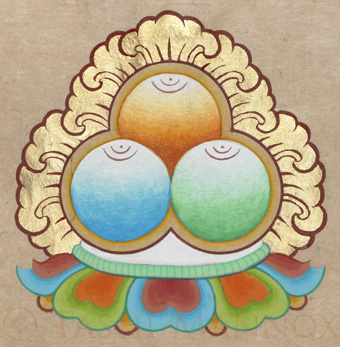
This is typically illustrated as above and at the top of the below calligraphy art piece; as three round precious jewels seated on a moon disk and multi-coloured lotus flower, the three jewels are decorated with a radiating golden leaf like pattern.


To take refuge is to simply put ones trust or confidence in those who have fully liberated them selves from 'samsara' such as a Buddha, by following the Dharma teachings with the guidance of the Sangha on the path to enlightenment. Until i am free from confusion and suffering, i take refuge in the Buddha, Dharma and Sangha.


The Threefold Refuge:

"Homage to the Three Jewels" 57x84 cm ⓒ Tashi Mannox 2012.
Available as a limited edition print.

The above calligraphy art piece illustrates from top to bottom four classic calligraphy traditions of India, Tibet and Ireland:

~ Sanskrit Lantsa that reads namo buddha ya, namo dharma ya, namo sangha ya.
The Buddhas teachings were originally transcribed in Sanskrit belonging to India, that has evolved over the centuries into many different forms of script styles. Lantsa was a very early such style that many of the Buddhist manuscripts were created in. It was these Lantsa manuscripts that migrated into Tibet and formed the bases from which the Buddhist teachings where first translated into Tibetan.

~ Tibetan Uchen script this is a phonetic translation of the above Sanskrit that also reads as namo buddha ya, namo dharma ya, namo sangha ya.
It is said that the Uchen script style was evolved to accommodate the translation of Sanskrit manuscripts from India, indeed there are some similarities in construction and letter forms, though Tibetan is a totally different language to Sanskrit, many original Sanskrit terms and mantras where maintained phonetically in Tibetan, as to preserve the original sound and to up-hold what was considered a sacred language, such as Latin is to Christians. 

~ Petsug script that is a translation of the above in Tibetan that reads sange la chag-sal lo, chö la chag-sal lo, gendun la chag-sal lo, meaning to bow down with folded hands to the Buddha, Dharma and Sangha. 
Petsug is one of many handwriting styles of Tibetan calligraphy, quicker to form than the Uchen script, it was commonly used to scribe manuscripts. 

~ Celtic English script that is a translation and phonetics of the original Sanskrit.
Perhaps a sacred English script; historically the great Christian manuscripts were scribed in Celtic scripts, which did not belong only to Ireland as we know it today, but the Celtic Christian influence spanned over Scotland, Wales, England and into Europe. 

Created for an exhibition in December 2012 at the Contemporary Calligraphy museum in Moscow. Chinese ink and Japanese mineral paint, 23.6ct gold leaf on Bhutanese tsasho paper, ⓒ Tashi Mannox 2012.


"homage mudra" 48cm diameter, ⓒ Tashi Mannox 2012.  


Another new piece by Tashi Mannox is to illustrate the 'mudra' of folded hands at prayer, painted in the way of traditional Thanka draftsmanship, there is a modern twist of folded back Western shirt sleeves and wrist watch on the traditional depicted arms and hands. 
Mudra means 'gesture' above the gesture of prayer is the word 'namo' meaning homage, this is in the Sanskrit Wartu script painted in a Japanese mineral earth red, below which in Tibetan Tsugmakhyug script translates as "hands held together at the heart in the gesture of prayer".


The Fourfold Refuge:

"Homage the the Fourfold Refuge, 54x84 cm
ⓒ Tashi Mannox 2012. 
Available as a limited edition print.

The main body of calligraphy of the above Four Refuges piece is painted in a historic 'high' form of Uchen, inspired by a 16th century manuscript from the seat monastery 'Tsurphu' of the Karmapa Lama's in central Tibet.
The Four Refuges: 'Lama, Buddha, Dharma and Sangha' are highlighted in rust red mineral paint. 

The first dark maroon characters 'na mo' in the Lantsa Sanskrit script translates as 'homage' at the end of the prayer is a 'full stop' character in the same Lantsa Sanskrit script.
The smaller lettering in red also at the end of the refuge prayer, translates as "the four fold refuge" 


In the Tibetan Buddhist system the Lama or Guru has become an equaled source of refuge, who a realized personal known as a 'root' teacher who has the ability to guide and point out the nature of ones mind, is called a Lama. 

Private collection. Chinese ink and Japanese mineral paint on Bhutanese Tsasho paper ⓒ Tashi Mannox 2022.


Monday, 13 September 2010

Guinness Book of Record Calligraphy.


Catalogue pages from the III International Exhibition of Calligraphy 2010.


The III International Exhibition of Calligraphy held in Russia's Novgorod State, 10-125th September 2010, boasts a record breaking success. The worlds largest project of its kind housed more than 300 artworks from internationally renowned calligraphy artists; including a major calligraphy piece especially created by Tashi Mannox.
Though the exhibition spanned only three days, it was visited by an astonishing 37,000 people. The exhibition is next planned to go on a world tour, starting in Paris early 2011.


★


Friday, 30 July 2010

Pure Perception


“Sacred Mantra” 73x56 cm Chinese ink and Japanese mineral paint on Heavy watercolour paper, created by © Tashi Mannox 2010 for the III International Exhibition of Calligraphy 2010


The description of the above calligraphy art piece features two main elements of sacred calligraphy:
1. The Mani mantra in the White vertical Phags-pa script:
The neo-Mongolian/Tibetan Phags-pa script was devised as a uniformed style by the Tibetan Lama ‘Blo-gros rGyal-mtshan’, during the regime of the Great Kublai Khan 1260-1294.
Phags-pa was also known as the new Mongolian script called Horyig in Tibetan. This was imperially imposed as a national script of the Mongol empire of the Yuan dynasty 1271-1368 encompassing all of China.
This particular Phags-pa script style used by Tashi to represent the famous Mani mantra of compassion, originates in 1348. This was discovered scribed on stone tablets at Juyonguan in China, located at the nearest section of the Great Wall to Beijing.
Only fragments of this beautiful form of Phags-pa style survives today, great effort and research were made to resurrect the Mani mantra to a correct representation in this rare script style, much due to the guidance of Andrew West, who is an expert in ancient scripts of the Far East.
The Phags-pa script bears some resemblance to Tibetan but differs distinctly in that it is written vertically downwards in columns running from left to right, much like Mongolian. Units are often formed of several characters that are separated by spaces.
From top to bottom the Phags-pa script reads om ma ni pad me hum.
2. The wishing prayer occupies horizontal lines of dark indigo ink in the Tibetan Dru-tsa script style:
Dru-tsa is one of the several U-med script styles, which is traditionally used for more ornamental calligraphy. The cursive form of the characters lends its self well to a more free style calligraphy that can be skilfully expressed in longer elegant tails and vowel signs.
In contrast to the architectural structure of the Phags-pa script, is a wishing prayer to engender a pure perception of our world being a divine heavenly realm, that all beings are the embodiment of loving kindness; the Bodhisattva Avalokitesvara and all sounds vibrate the sound of the six-syllable mantra. A full translation of this pure perception prayer is shown below:

Integrating everything into the spiritual path:

Each and every being in this universe is Avalokiteshvara, the embodiment of compassion,
Every sound heard hums the melody of the six sacred syllables,
This very place is truly the Pure Land of Great Bliss,
Devoid of any actual reality, like a magic show, like a dream.
It is as though we had already been reborn there.
As we cultivate “pure perception” with great joy, all veils are cleared.
One should practice “pure perception” in the way explained above.
Translation by Katia Holmes 2010

The blue ‘Utpala’ lotus represents transformation from relative to ultimate; on the open lotus is a white moon disc, which represents stainless purity. Emanating vertically from the seat of the lotus is the Mani mantra. The background of green to blue swirls suggest the water on the pond of Saṃsāra, the ocean of suffering for which compassion and understand is engendered.


oṃ maṇipadme hūṃ

The Mani mantra in 'high' Uchen script style, © Tashi Mannox 2010.


This year the Contemporary Calligraphy Museum hosts The III International Exhibition of Calligraphy 2010 in the historical Russian town of Velikly Novgorod. The main theme of the exhibition is 'Sacred Calligraphy', which the above piece called 'Sacred Mantra', was create by Tashi and donated to the Contemporary Calligraphy Museum especially for this particular calligraphy collection.

The exhibition extravaganza features art pieces of world class calligraphy artists from 43 countries, opens and runs September 10th -12th 2010.


❖


High Uchen script style on a base of Lapis-lazuli stone effect, this translates as
"(Spontaneously) Sacred Calligraphy". The most precious of Tibetan calligraphy is said to be embossed in gold on tablets of Lapis-lazuli stone, of which this art piece emulates. © Tashi Mannox 2010.

❖


Friday, 18 September 2009

Capital of calligraphy


Merit of right action. 61x64 cm, Chinese ink ans Japanese mineral paint on a wash of pure saffron. Tashi Mannox 2009

The main body of text in the Dru-tsa script reads:

I fully abandon bad deeds,
but engage fully in all meritorious actions.
In the pure merit of all beings,
in all their virtuous deeds, i rejoice.

The smaller Petsug script is in reference to the composer of this wishing prayer, named Phag pa Lundrub. This calligraphy piece was especially commissioned by The Moscow Contemporary museum of calligraphy, july 2009.


In July 2009 the Contemporary museum of calligraphy in Moscow invited Tashi to join their body of participants of world class calligraphers. The 80 project participants have all contributed calligraphy master-pieces to the museums permanent and touring exhibitions. Tashi is the only contributing artist in Tibetan calligraphy and the only participant representing Great Britain.

The above calligraphy on saffron yellow, was especially commissioned by the Contemporary museum of calligraphy, for their permanent collection, This piece will be added to the sacred calligraphy section that also consists of Orthodox, Islamic and Judaism works. These pieces and more will feature in the sacred calligraphy collection of their 2nd International exhibition:


The II International exhibition of calligraphy

October 15 — November 14 2009
In 2009 Moscow became the capital of calligraphy, boasting the largest exhibition of calligraphy in the world.
It is where the Orient meets the West, professional artists speak to amateurs, classical calligraphy joins ultramodern art pieces. The exposition will feature art works from 33 countries: refined Slavonic and European calligraphy, traditionally reserved Japanese and Chinese creations, elegant scripts of the Hebrew and Arabic calligraphy schools.
The metropolitan audience has a rare chance to see valuable handwritten books, calligraphy masterpieces included in the Guinness World Records. Visitors may participate in mink-festivals of the Japanese, Tibetan and Slavonic cultures and visit calligraphy master-classes.
The exhibition is organized under the aegis of the Commission of the Russian Federation for UNESCO and supported by the Ministry for cultural affairs of the Russian Federation. Also the exhibition was officially recognized by the Russian Orthodox Church, the Russian rabbinate, Russian Council of Muftis and Buddhist organizations. This all emphasizes the special significance of the coming event for the cultural heritage.
From October 14th 2009 walls of the unique 4,000 sq.m. “Victory” pavilion will host art pieces of 100 calligraphers from 33 countries. Near 200 calligraphy master-pieces will be demonstrated for the first time.


Also, on lone to the calligraphy museum, is a selection of Tashi's other calligraphic works, these include a piece each from his Contemporary Tibetan, Black on Black and Illuminated iconographic series. These will be shown until 2014, on a touring exhibition that will be held in the words leading cities, starting with Paris.

More details of Tashi's contribution of pieces to the museum can be seen here.


Causality

57x76 cm, Chinese ink on heavy water-colour paper, Tashi Mannox 2009

One of the pieces on lone to the Moscow contemporary museum of calligraphy.


Another blog worthy of a visit, which could be said to be the most bang-on and informative Buddhist blog ever created. Please take some time to visit the "Digital Tibetan Buddhist Alter" who recently sang the praises of Tashi.