RELATED TIBETAN SCRIPTS

Thursday, 16 February 2012

Woodblock Politics.


Annie Bissett is a talented American artist who creates contemporary woodblock prints by the traditional Japanese method called moku hanga or ukiyo-e. 

The above print called "Train to Lhasa" 33x33 cm, illustrates the copy of a traditional Tibetan "wind-horse prayer flag" that is broken by the intrusion of Chinese letters that translate of "Take root in the countryside while keeping the world in your heart".
Since the Chinese built railway forged its way into the heart of Tibet; making easy access to a previously isolated land of saints and snow, the demise Tibet's unique culture and way of life has been accelerated. 

As Japan, Tibet has a tradition of woodblock printing. A survivor of this tradition is the 'Dege Pakhang' a printing house in Sichuan province of East Tibet. The 'Sutra' print house holds more than 20,0000 wood blocks of Buddhist literature of the great classical scriptures and other historical, medical and astronomical editions. 

Below another Annie Bissett woodblock print called "Honey, I'm worried about the kids" 26x37 cm, that shows a Dutch family of early setters in America, against a background of modern graffiti.


Saturday, 11 February 2012

Printing black པར་ནག།

"Homage to Mahakala" now available as prints.

"homage to Mahakala" Ⓒ Tashi Mannox 2012

The Image of Mahakala the great black one, with his all seeing bulging eyes of the past, present and future, snarling and bearing teeth to bite trough ego clinging, is somewhat demon looking, though what Mahakala represents is the wrathful quality of compassion that is sometimes needed to cut through the more stubborn inner and outer obstacles, as we tread the precarious path to enlightenment. 

A protector of the Dharma, Mahakala is considered a manifestation of Buddha activity that as a Yidam practice transforms anger and hatred into lovingkindness and wisdom. For this reason it is especially practiced at the end of the old year, to chase away any old baggage and obstacles to clear a way for the new year. 

This particular image of Mahakala, bearing his name as his teeth, has been popular and admired by many who have asked its availability as a print. 

Tashi is pleased to say that after some very skillful photography by professional means, plus much attention and care to maintain the subtly of the multilayered effect of the black on black inks, that was previously not thought possible to replicate. It is now available to order a limited edition print of this iconic image.

To give the prints a special dimension, the eyes iris are hand gilded with 23.6ct red pure gold leaf, that illuminate and enrich the prints splendor.

The prints are limited to editions of 100 in three sizes:

- Large size of 67x50 cm, 26½"x19¾" inches @ £395 GBP
- Half size of 50x37.5 cm, 19¾"x14¾" inches @ £295 GBP
- Small size of 35x26 cm, 13¾"x10¼" inches @ £255 GBP


As reproductions are printed to order and hand finished, delivery of prints may take from 5 days to two weeks to arrive from the date of payment.
Additional Post and shipping costs may vary depending on where you are based in the world, please provide the address you wish the print to be sent to when contacting Tashi, so that the correct costs can be calculated and quoted.


Design originally by Tashi's master of art Sherab Palden.


Tuesday, 31 January 2012

Illuminated Manuscripts exhibition

From the 6th April -September 3rd 2012, The Rubin Museum of Art in New York City presents the exhibition 'Illuminated': The art of sacred manuscripts explores the aesthetic and technological approaches in creating and adorning books from a variety of cultures and features illuminated Tibetan manuscripts dating as early as the 13th century.

A detail of a 17th century Tibetan manuscript.
Take the link here for more details on the exhibition.

Sunday, 29 January 2012

Creating a golden world


The word gser in the Petsug script
meaning 'gold'.

The Creation process of the calligraphy art piece called "Primordial Purity, Golden World"


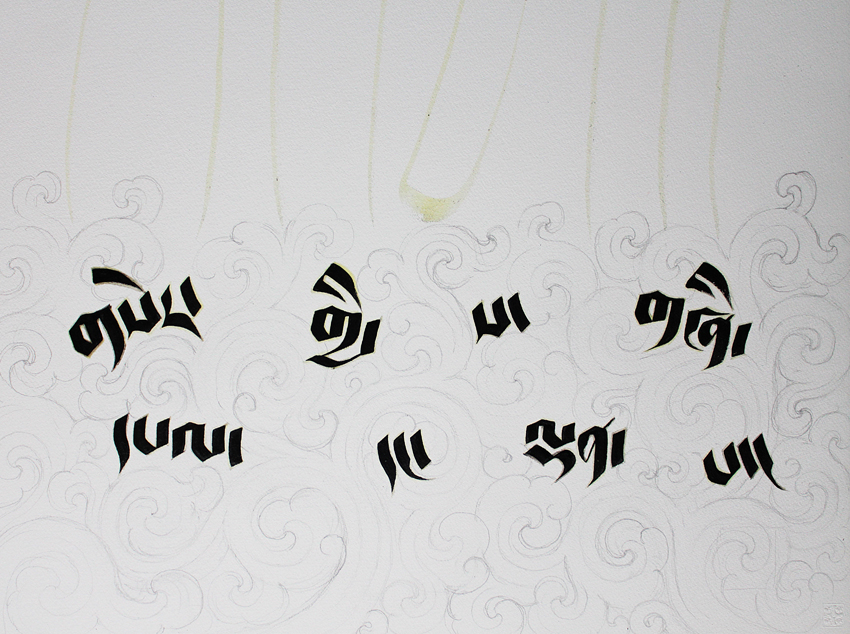
First calligraphy in black ink that is set out with ample space to draw in a swirling leaf like pattern to be later painted and gilded. This particular calligraphy style is called Petsug script, that has a compact square bold character, purposely placed irregular as if to dance across the paper. The text translates as "the mythological golden basis/ground of our know world, that is glorious and magnificent"


Other calligraphy painted with a latex rubber masking fluid that resists any water based paint. The above detail shows the rubber mask being removed with an eraser to revile the clean white paper below. The below image shows the calligraphy in full, these words at the top of the piece are painted in a long tailed form of the cursive Drutsa script, known as 'round tailed Drutsa', that translate as 'universal, common ground of primordial purity'.


Shades of yellow ochre pigment provides a suitable base to apply both gold and copper leaf. The top and bottom calligraphy together translates as 'The universal basis of primordial purity (of our mind/being). The glorious golden ground (of our world).


Above, a detail showing gold and copper leaf mapping out the swirl pattern.


A mass of swirling gold and copper leaf reflects the light brightly on the rough texture of the water-colour paper, where light is not reflected the swirl pattern appears darker than the background yellow ochre. 


Primordial Purity, Golden World.

The universal basis of primordial purity (of our mind). The glorious golden ground (of our world)
The splendor of the universe, our world, from where we are born and return, can be experienced by us from a sacred viewpoint of our innate purity that is naturally within us. This interrelationship between heaven and earth evokes the creativity of man, expressed in words and the beauty of calligraphy.
The uppermost line of Tibetan cursive script that soars high in the sky translates as “universal, common ground of primordial purity”. Below, as if dancing among the swirling energy of the earth are black letters that translates as “the mythological golden basis of our known world, glorious and magnificent”. 
ⓒ Tashi Mannox, 
53x76 cm Dutch gold and copper leaf on a ground of acrylic paint.

Limited edition prints are also available of this art piece and two others that feature in the Sharjah Calligraphy exhibition, for all enquires and to place an order for a print, please contact Tashi Mannox here.


The word 'truth' in an ornamented Petsug script style, this is a detail of a larger art piece created for the Sharjah Calligraphy Biennial 2012. this is also available as a limited edition print and is shown in full, featured here.


All images shown in this post ⓒ Tashi Mannox 2012


Saturday, 28 January 2012

Sharjah Calligraphy Biennial 2012


From April 1st to May 1st The Sharjah Calligraphy Museum in the United Arab Emirates hold its biennial exhibition of not only Islamic calligraphy, but for the second term running has invited internationally celebrated calligraphist of other traditions including Tibetan calligraphy to participate.

Tashi Mannox -
"i am delighted to be invited back to exhibit with the Sharjah Calligraphy Museum, as i have always held a high regard for Islamic art. Islamic Calligraphy could be argued to be one of the most evolved and decorative writing systems of the world, so i feel particularly honored to be exhibiting along side such excellence. 
This time the theme "Universe" see below was given to inspire the participants in their creations for the exhibition. This lead me to create three pieces for the exhibition, exploring the interrelationship between heaven and earth, the ultimate and the relative spirit of mankind".

Two of three art pieces submitted by Tashi are shown below, the second piece "The Great Perfection Aa" can be seen in an earlier blog post here.

The Absolute and Relative Truths.

When speaking of the spirituality of man, this implies an ultimate or absolute that is pure and next to godliness. If there is ‘absolute’ then there must be ‘relative’ which can be considered mundane and unholy. These two ways of existence can be called the two truths of absolute and relative.

Psychologically in the realm of heaven and earth, the ‘absolute’ is symbolically placed above and the ‘relative’ is placed below. Just as the calligraphy, the words ‘absolute truth’ is above and ‘relative truth’ is placed below.
The Tibetan script style used is a form of ornate Petsug, typical of holy manuscripts. The lower most line of text translates as “The thatness of the two truths”.


Especially created for the Sharjah Calligraphy Biennial 2012 ⓒ Tashi Mannox, 57x84 cm Chinese ink and Japanese mineral paint on Bhutanese Tsasho paper.


The Absolute and Relative Truths. ⓒ Tashi Mannox 2012
-----------------------------------


"Universe"
As given as a brief to the participants of the Sharjah Calligraphy Biennial 2012

The letter remains not only as a means of expression within the linguistic context but also it is used as an instrument for research in the spaces of light which rules the making of time and space. This is due to the interrelationship of antitheses of the knot of existence or to the merger of components in the splendor of the universe and nature.
The artist, who through his consciousness, gets his inspiration from those possible and potential relationships, embodied in the mosaics of this great universal painting, takes the spirituality of his soul and creativity, to bring these facts closer to each other, and, discovers the individuality of the letter, being an image and an echo of the greatness of the creator and Man.
The rich experience of the artist shows that the letter is a universe by itself, from which all meanings of existence stem. It is a mirror that reflects all the visual revelations that are enriched with knowledge and infinite light, revealing a spirit extending towards psychological and subjective links.
The letter, therefore, is the key of reflection and search for similarities and differences to gain more faith.

Sharjah, as usual, opens this forum, Sharjah Calligraphy Biennial, to be a source for the creative art of calligraphy, revealing the renewable and infinite worlds of innovation in this field. In its new session, the biennial presents a new space for reflection, and  re-production, leading to an intellectual and innovative spheres, revealing an infinite artistic creativity.


Tashi Mannox looking at traditional calligraphy pens
during the opening of the Sharjah Calligraphy Biennial
2012.

Islamic Calligraphy, practiced here with a bamboo pen,
Just as traditional Tibetan calligraphy.

Sunday, 22 January 2012

The practice of the Bodhi

ⓒ Tashi Mannox 2012


སྡུག་བསྔལ་མ་ལུས་བདག་བདེ་འདོད་ལས་བྱུང་༎ 
རྫོགས་པའི་སངས་རྒྱས་གཞན་ཕན་སེམས་ལས་འཁྲུངས༎ 
དེ་ཕྱིར་བདག་བདེ་གཞན་གི་སྡུག་བསྔལ་དག། 
ཡང་དག་བརྗེ་བ་རྒྱལ་སྲས་ལག་ལེན་ཡིན༎ 

All suffering, without exception, comes from the desire for happiness for oneself
While perfect Buddha-hood is born from the desire to make others happy. This is why completely exchanging one's happiness for that of others is a practice of the bodhisattva.


This calligraphy is based on the above prayer to develop bodhicitta, written in full of the smaller བྲུ་ཚ་ཞབས་སྒོང་མ 'round tailed Drutsa' script, a style popular in Tibet from the 1200s. The Circle of larger Uchen script is a repeat of the first line of the decree, while in the very center is the Sanskrit word 'bodhi' in uchen phonetics.

Wednesday, 11 January 2012

The Great Perfection རྫོགས་པ་ཆེན་པོ


The Great Perfection of 'Aa'. 57x76 cm, Black Chinese ink
on heavy water-colour paper.  ⓒ Tashi Mannox 2012.


The central character illuminates white and resplendently pure among aura like swirls spinning from the blackness of limitless space.
As this is the root syllable ‘a’in the classical Uchen script, the last letter of the Tibetan alphabet, from which all other sounds are produced, it is considered essentially pure and stainless. It represents the ultimate true nature of mind, which is equaled in all beings, who are countless as all the stars of the universe.
The lower line of calligraphy in the Tibetan Petsug script translates as “The ultimate true nature of the uncontrived great perfection dzogchen that is embodied and expressed in the sound of the essential syllable ‘a’.”

གཤིས་རྫོགས་པ་ཆེན་པོར་མ་བཅོས་ཨ།

The above art piece "The Great Perfection Aa" was especially created for the Sharjah Calligraphy Biennial April 2012, the exhibition called “Universe” hosts celebrated Islamic calligraphy artist along with a few international artist of other denominations. 


This image is now available as limited edition prints of three sizes:
Large size 57 x 60 cm or 22½" x 30" inches
Medium size 50 x37.5 cm or 19¾" x 14¾" inches
Small size 35 x 26 cm or 13¾" x 10¼" inches


The reproductions are premium-quality giclée printed, on a heavy weight museum conservation rag paper, ensuring stability and a colorfast longevity.

Each image is carefully colour matched and in sharpness to the original artwork. The prints are edition numbered and hand signed and stamped with the artists’ personal seals. 

To place a print order, please follow this link to the TashiMannox on-line store.


Constructing the art-piece,  January 2012.