RELATED TIBETAN SCRIPTS

Wednesday, 7 December 2011

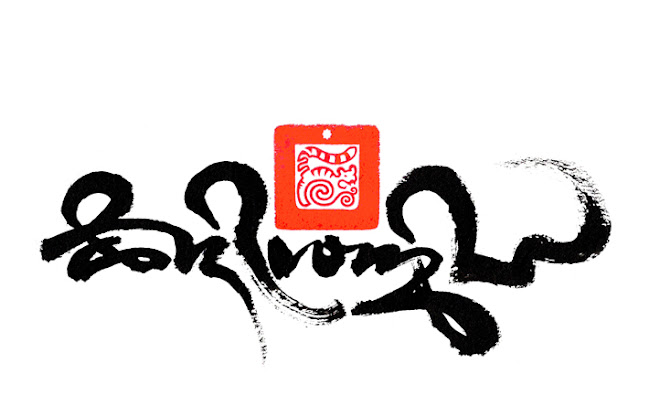
Creating the Mani mantra


The Mani mantra is featured in this five minute video, that demonstrates the calligraphic order in a brushed Uchen script, Tashi also gives a short explanation of the purifying nature of each of the six syllables:

oṃ ma ṇi pad me hūṃ 

Created on 5th December 2011
Chinese ink on block water-colour paper 46x61 cm.
© Tashi Mannox


Friday, 2 December 2011

Bodhicitta

A detail of the "Beautiful Bodhicitta"

A person who has Bodhicitta (awakened mind) aspires to become enlightened for the benefit all beings, for their ultimate happiness and liberation. When a person reaches that level of unconditional love, compassion and understanding, he or she can then be called a Bodhisattva.


"Beautiful Bodhicitta"  2009.
 © Tashi Mannox 

Calligraphy in Chinese ink, Japanese mineral paint, on a wash of pure saffron depicting a landscape of the sun and clouds over mountains and foot-hills, river and the sea.
The Tibetan Drutsa script translates.....


“As a river to the sea, 
as the sea to the clouds,
as clouds to the land,
So does Bodhicitta beautify this world.”


A praise of Bodhicitta from “This Jewel Lamp” composed by Lama Tenzin Gyaltsen in Varanasi, India.

"Bodhicitta" in the ancient Wartu Sanskrit.
 © Tashi Mannox 2011


Sunday, 27 November 2011

rest unshakably.....


"Rest Unshakably" Chinese ink and silver leaf on mount board.
50x51 cm Tashi Mannox 2008.

The translation for swastika in Tibetan is "unchanging well-being" or "rest unshakably" a popular emblem in Tibetan iconography used to mark stability as well as a symbol of good luck.

An art piece previously not published as part of Tashi's Black on Black series, This particular piece is created using the words yungdrung གཡུང་དྲུང་ repeated four times to arrange as a mandala of unchanging well-being. These Tibetan letters gilded in silver leaf to give an etched effect standing proud on the blackened textured board, as the below image details demonstrate.

Detail showing the artists seals and date.
In the bottom right corner accompanying two of the artists personal seals are the words "the mandala of unchanging well-being" ༄། གཡུང་དྲུང་འཁྱིལ་བ། that is only caught in certain light or angle that painting is viewed.
The artists signature appears untypical and lavish across the bottom width of the canvas size, painted in a free brushed expression that is actually a remanent from an earlier discarded art piece, re-used to an attractive effect and multi layering and texture to the over-all piece. Other words that translate as "the great gesture" "Mahamudra" are hidden and pushed to the background by the illuminated silver lettering.


During the 17 years of being a monk, Tashi Mannox spent four in a cloistered retreat, The photo below was taken in 1988 at the begining of the retreat, that shows Tashi seated in his 'meditation box'. This limited  space of about a meter square doubled as his bed, as it is required to sleep up-right to maximize time spent in meditation during the retreat. Chalked below the box was a swastika as protection and a symbol of stability and well-being. As Tashi commented "though it took some months of getting used to, the meditation box became a place to 'rest unshakably' with only one's mind as a distraction".


To read more about the symbology and relevance of the swastika, there is an earlier post on the subject here.

Wednesday, 23 November 2011

Tibetan Graphic Design


A design on the word 'phur in the Tibetan Uchen script,
That translates as 'rub' or  'to fly'. 

Native Chinese and London educated 顾翔 Xiang Gu is a photographer and Graphic designer, that has the rare ability to join technology and design of east and west. His talent is clearly demonstrated in his fresh and innovative creations.


The above Graphic design by Xiang Gu is based on the word འཕུར་ 'phur in the Tibetan Uchen script. This is a word that has a number of meanings, such as 'rub' and 'scratch', but by the Art Deco appearance of the lettering, it seems that Xiang Gu has focused on the translation of phur as 'to fly'.


Below is another of his creations that shows the Tibetan alphabet in a neon like 'Tron' style font, though the letter design does not always follow the logical rules of the Uchen script, it is never-the-less a curious and modern take on the Tibetan alphabet.  

More of Xiang Gu's work can be seen on his slick website and blog.


Tron has become a font style for the classic electronic game; based on the 1982 Tron Disney film about a programmer who gets stuck into his computer and it's electronic world.


Tuesday, 1 November 2011

Bamboo pen


Tibetan artist strives to sustain traditional calligraphy
LHASA, TIBET, Nov 1st 2011 Xinhua Chinese news paper reports -- 
Kalnor is among the few people who still practise traditional Tibetan calligraphy with a bamboo stick on a wooden board.
The 50-cm long, 25-cm wide birch board, known as "jangshing" in Tibetan, was an essential stationery item for Kalnor and his peers when they first learned to write.
"We had to practise on the jangshing for at least two years before we could write on paper," said Kalnor, 31.
The jangshings for beginners were often marked with four lines, and the number of lines was reduced as the students' writing improved, until only one line was left to mark the location of the text.
According to Kalnor, the ancient writing material was economical and green, as old jangshings could be used anew after being washed in the river and dried again.
Image showing the traditional birch wood board called a jangshing.
As a child, Kalnor used bamboo sticks for a pen. The makeshift ink almost always came from the kitchen -- charred barley or soya sauce.
"When we wrote on the jangshing, we sat on the floor with legs crossed and wrote every stroke with patience," Kalnor said. "It was not just a practice of calligraphy -- it was also a process of extreme concentration and meditation."
The jangshing is dusted with chalk through which the letters are practiced
with a bamboo pen dipped in water.
A master of fine arts, Kalnor is now an art teacher at a secondary school in Duilong Deqing County on the outskirts of Lhasa. "Children who learned to write with the jangshing concentrate easily on everything they do."
The past two decades of modernization, however, have led to the traditional writing boards being replaced by well-printed exercise books and computers. Few children still use the jangshing even in the remote herding areas.
Beginning in 2008, Kalnor traveled across Tibet searching for jangshings and expanding his private collection of the traditional writing pad that will soon fade from the public memory.
"It would be a pity if we lose this part of Tibetan culture," said Kalnor at his gallery on Barkor, a famous commercial street in the heart of Lhasa.
Kalnor has proudly put his favorite jangshing collections on display at the gallery, including one inherited from his father. The jangshings were shown alongside his modern Tibetan paintings on handmade papers and works of butterfly and Tara -- a female Buddha in Tibetan Buddhism.
Phubu Tsering, a visitor to the gallery, said he still remembered how he learned to write the Tibetan alphabet on a jangshing when he was 6.
"My mother made me some ink by adding water to barley flour that was fried dark. Sometimes she added sugar to make the liquid thicker, and I used to suck my 'pen' to taste its sweetness," said Phubu Tsering, 46.
For many Tibetans, jangshing and traditional Tibetan calligraphy are an important part of their collective memory.
"Many things of the good old days will be replaced by new things, and it might not be practical to keep jangshing, but this writing tool certainly played a major role in Tibetan education, so we should at least carry forward the essence of the traditional culture it represents," Kalnor said.
Tuesday, 25 October 2011

Threads of Awakening

Manjushri appliquéd in fine silks by Leslie Rinchen Wongmo.

In regard to the beautiful creation above, Leslie Rinchen Wongmo, master of Traditional Thangka appliqué quotes:

"Manjushri is the embodiment of all the buddhas’ wisdom. His flaming double-edged sword cuts through layers of misconception to discriminate clearly between the independent way things deceptively appear to exist and the interdependent way in with they actually arise. Resting on a lotus in his left hand is the text of the Perfection of Wisdom sutra, considered to be the Buddha’s most profound teaching on the ultimate nature of reality."

The Manjushri mantra om a ra pa tsa na dhi
in the High Uchen script with heading character.
Tashi Mannox 2011

Leslie recently posted a blog about her personal seal design she originally commissioned Tashi to create and tells the story of how she chanced on meeting Tashi, how he created her seal design that ten years on become the logo for her new website 'threads of awakening' showing her beautiful appliqué masterpieces. 

Leslie's personal seal meaning
Rinchen precious in the
Horyig seal script.

If you are interested in commissioning your own bespoke seal that can also be used as a logo, all that you need to know about seal design and how to order is clearly explained on the page link here:


རྒྱ་


Monday, 10 October 2011

holy trends

Tashi Mannox October 2011

An expressive calligraphy of the word 'moustache' in Tibetan Drutsa script.


The 13th Dalai Lama, Thubten Gyatso 土登嘉措
1876 - 1933.
His Holiness the 13th Dalai Lama sporting a rather dapper mustache; the fashionable look of a gentleman in the 19th century.

The 13th Dalai Lama predicted the 1959 Chinese invasion of Tibetan and announced that he would die early, in order that his incarnation successor, the 14th Dalai Lama Tenzin Gyatso, would be old enough to act as a leader of the Tibetan people at the time of the invasion. He died a few months later in Lhasa, December 1933.

A long life prayer for the 14th Dalai Lama, born 6th July 1935.
Tibetan Petsug Calligraphy - Tashi Mannox 2011.


 〰